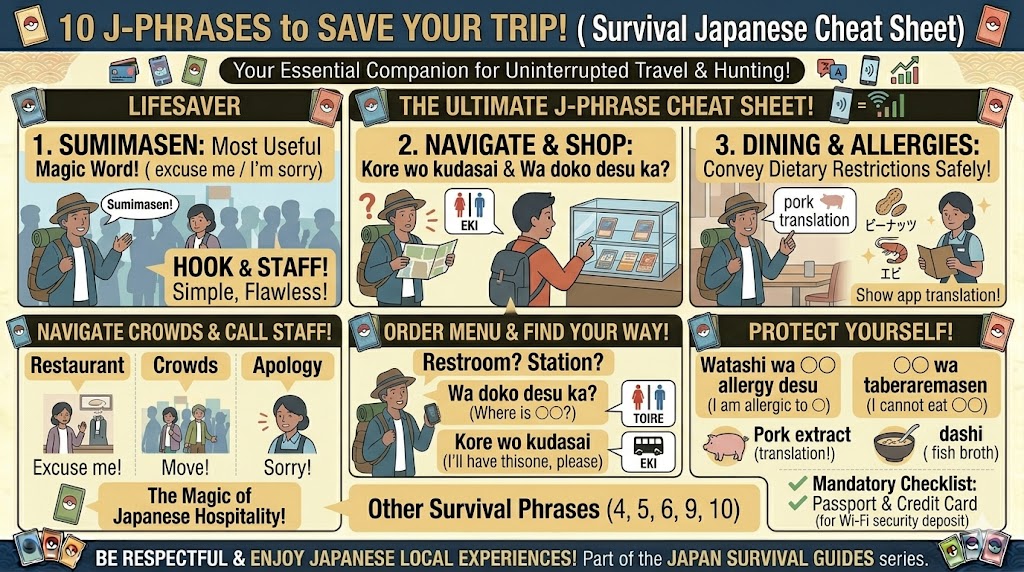
Help is Here! 10 Essential Survival Japanese Phrases for Travelers
Japanese people are generally thrilled when foreign visitors make the effort to speak even a little bit of Japanese. Don't worry about having perfect pronunciation! Take a screenshot of this page or bookmark it, and don't be afraid to dive into local Japanese experiences.
Even in massive cities like Tokyo and Osaka, you will inevitably encounter local restaurants and shops where English isn't spoken. But don't worry! Memorizing just a handful of basic Japanese phrases will make your trip incredibly smooth and open doors to amazing local experiences.
Here are 10 strictly essential "survival" phrases you need to know for navigating streets, card shops, and menus in Japan.
The Ultimate Magic Phrase
1. "Sumimasen" (Excuse me / I'm sorry)
Meaning: Excuse me / I'm sorry.
How to use: This is the single most useful magic word in Japan. You can use it in almost any situation: to call a waiter at a restaurant ("Excuse me!"), to politely ask people to make way in a crowd, or to offer a quick apology if you bump into someone.
Navigating and Shopping
2. "〇〇 wa doko desu ka?" (Where is 〇〇?)
Meaning: Where is 〇〇?
How to use: Essential for when you get lost. Just put what you are looking for in the blank.
Toire wa doko desu ka? (Where is the restroom?)
Eki wa doko desu ka? (Where is the train station?)
3. "Kore wo kudasai" (I will have this one, please)
Meaning: I'll take this, please.
How to use: If you can't read a menu or want to buy a specific card from a glass showcase, simply point to the item and say this phrase. It works flawlessly every time!
4. "Credit card wa tsukaemasu ka?" (Do you accept credit cards?)
Meaning: Do you take credit cards?
How to use: Many local spots in Japan (especially small ramen shops or older stores) are strictly cash-only. It is always smart to ask this before you place an order or bring items to the register.
Dining, Dietary Restrictions, and Allergies
5. "Eigo no menu wa arimasu ka?" (Do you have an English menu?)
Meaning: Do you have an English menu?
How to use: Many restaurants actually keep English menus hidden behind the counter for foreign guests, so always ask this right after you sit down.
6. "Okaikei wo onegaishimasu" (Check, please)
Meaning: Check, please. / I'd like to pay.
How to use: Say this to the staff when you have finished eating and are ready to leave. Tip: Making an "X" shape with your two index fingers is also a widely understood gesture for "check, please" in Japan.
[IMPORTANT] Conveying Dietary Restrictions and Allergies Japanese food often uses hidden ingredients like pork extract or fish broth (dashi) for flavor. If you have life-threatening allergies or religious dietary restrictions, use these phrases (and show them a translation app on your phone) to be absolutely safe.
7. "Watashi wa 〇〇 allergy desu" (I am allergic to 〇〇)
Meaning: I am allergic to 〇〇.
Vocabulary: Peanuts (Peanuts) / Shrimp (Ebi) / Wheat (Komugi)
8. "〇〇 wa taberaremasen" (I cannot eat 〇〇)
Meaning: I cannot eat 〇〇.
How to use: Use this for vegetarian, vegan, or religious dietary limits.
Vocabulary: Meat (Niku) / Pork (Butaniku) / Beef (Gyuniku) / Fish (Sakana)
Basic Communication
9. "Wakarimasen" (I don't understand)
Meaning: I don't understand.
How to use: Use this if someone speaks to you in fast Japanese and you are completely lost. It is highly recommended to follow up with: "Eigo wo hanasemasu ka?" (Can you speak English?).
10. "Arigatou gozaimasu / Gochisou-sama deshita" (Thank you)
Meaning: Thank you / Thank you for the meal.
How to use: Say "Arigatou gozaimasu" when leaving a shop, and "Gochisou-sama deshita" when leaving a restaurant. Say it with a smile, and the staff will surely smile right back!