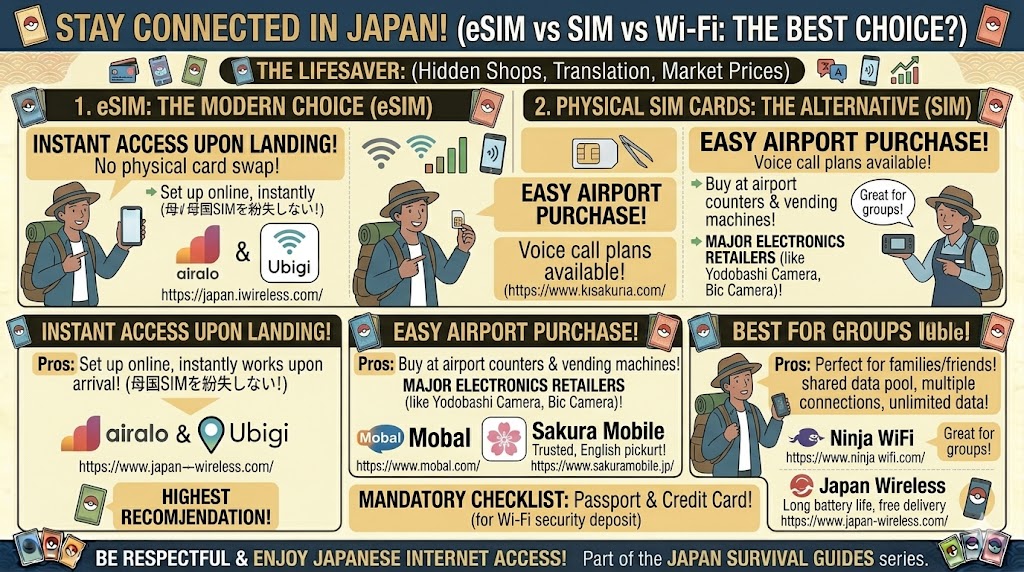
Getting Connected in Japan: eSIM vs. SIM Cards vs. Pocket Wi-Fi for Tourists
Which One is Right for You? ・Best for Speed & Convenience (Solo Travelers): Buy an eSIM via apps like Airalo or Ubigi before you depart. ・Best for Older Phones (Solo Travelers): Reserve a Prepaid SIM from a service like Mobal ahead of time or buy one at the airport. ・Best for Cost-Sharing (Groups & Families): Rent a Pocket Wi-Fi from Ninja WiFi or Japan Wireless to keep everyone connected at once. Secure your digital lifeline before you dive into the streets, and enjoy a completely seamless, stress-free TCG hunting journey across Japan!
Whether you're trying to navigate unfamiliar streets to find a hidden card shop, using a translation app to talk to store staff, or checking the latest card market prices on your phone, a stable internet connection is your absolute lifesaver in Japan.
While free public Wi-Fi has become more common, it is still far from reliable when you are on the move or inside basement shops. This guide breaks down the pros, cons, and best options for the three main ways to stay connected in Japan: eSIM, physical SIM cards, and Pocket Wi-Fi.
1. eSIM: The Smartest Modern Choice
If you use a relatively recent smartphone (such as an iPhone XS or newer, or a modern Android device), an eSIM is by far our highest recommendation. It allows you to download a digital cellular data plan instantly without swapping physical cards.
Pros: You can buy and set it up online before you even leave your home country. The moment your plane lands in Japan, your internet will work instantly. Since there is no physical card to handle, you don't risk losing your home country’s SIM card.
Cons: Your phone must be carrier-unlocked and compatible with eSIM technology.
Recommended Services:
Airalo:

One of the world’s largest and most popular eSIM apps. You can easily buy and activate their Japan data plans (such as the "Moshi Moshi" plan) directly through their user-friendly app.
Ubigi:

Highly favored by travelers for its excellent data speeds in Japan, as it operates on reliable local networks like NTT Docomo.
2. Physical Prepaid SIM Cards
If your smartphone does not support eSIM, purchasing a traditional physical "Prepaid SIM Card" for tourists is your go-to alternative.
Pros: These are very easy to buy at airport service counters, vending machines, or major electronics retail giants in the city (like Yodobashi Camera or Bic Camera).
Cons: You have to manually swap out your tiny SIM card. You will also need a safe place to store your home SIM card so it doesn't get lost during your travels.
Recommended Services:
Mobal:

Famous for its incredible English-language customer support. Aside from standard data-only plans, they uniquely offer plans that provide a real Japanese voice-calling phone number.
Sakura Mobile:
Another highly trusted service with great English support. They offer flexible pick-up options at major Japanese airports or can deliver the card directly to your hotel.
3. Pocket Wi-Fi (Portable Routers): Best for Groups
A Pocket Wi-Fi is a small, portable router that you rent for the duration of your trip. It radiates a personal Wi-Fi hotspot, allowing multiple devices to connect simultaneously.
Pros: Perfect for families or friend groups who want to share a single data pool. You can connect smartphones, tablets, and laptops all at once. Most plans also come with unlimited (or massive) data caps.
Cons: You must carry the device with you everywhere, and it requires daily charging. You also have to return the router at the airport or via a prepaid mailbox before you fly home.
Recommended Services:
Ninja WiFi:
One of the most famous Wi-Fi rental services in Japan, boasting numerous pick-up counters across major airports. Their unlimited high-speed plans are incredibly popular.
Japan Wireless:

Highly rated by international tourists for providing routers with extended battery life and offering free delivery options directly to your hotel or airport post office.
4. Purchasing and Pick-Up at the Airport
If you didn’t have time to arrange something before your flight, don't panic. The arrival lobbies of all major international airports in Japan (Narita, Haneda, Kansai, etc.) are lined with various telecom service counters.
How it works: Simply walk up to a counter and tell the staff how many days you are staying and how much data you think you need (e.g., 7 days, unlimited). The staff are highly accustomed to helping foreign tourists and speak great English—they will often even help you configure your phone settings right there.
What to bring: You will strictly need your Passport and a Credit Card to complete a purchase or rental (credit cards are especially mandatory for Pocket Wi-Fi rentals to act as a security deposit).