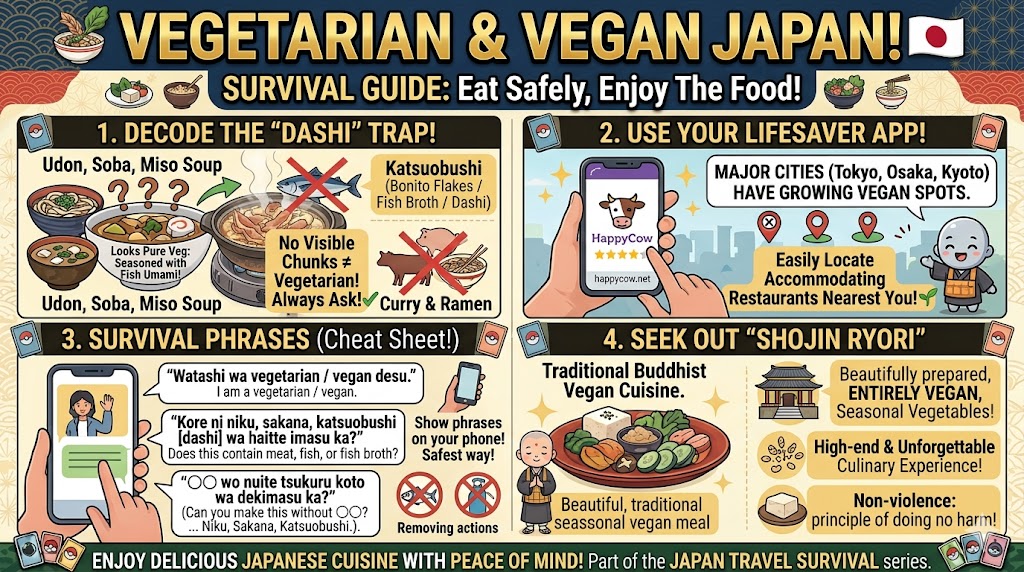
A Vegetarian and Vegan Guide to Dining in Japan: How to Avoid "Hidden Ingredients"
Japan's "hidden dashi" culture might seem intimidating at first, but with a little preparation and a handy app like HappyCow, you will do just fine. Keep your useful Japanese phrases ready, double-check your broths, and enjoy a fantastic and delicious vegetarian or vegan journey during your stay in Japan!
Sushi, tempura, udon... Japan is famous for its incredibly delicious and seemingly healthy cuisine. However, for vegetarian and vegan travelers, dining at a standard Japanese restaurant can be a surprisingly high hurdle.
In this guide, we will explain the "hidden animal ingredients" often found in Japanese food and share survival tips to help you eat safely and enjoyably during your trip.
1. The Biggest Trap: "Dashi" and Meat Extracts
The number one reason Japanese food is tricky for vegetarians is the heavy reliance on "Dashi" (traditional umami broth).
Even if a dish looks like a 100% pure vegetable meal, the underlying seasoning is very often made from animal products. Be extremely careful with the following:
Udon, Soba, and Miso Soup: The broth (soup) for these dishes is almost always made with "Katsuobushi" (bonito flakes / shaved fish).
Simmered Vegetables and Tofu: Dishes like Hiyayakko (chilled tofu) are frequently served with Katsuobushi sprinkled right on top as a garnish.
Japanese Curry and Ramen: Even if the visible toppings are strictly vegetables, the curry roux or soup base typically contains dissolved pork or beef extracts.
Cultural Note: In many standard Japanese restaurants, there is a common misconception that "if there are no visible chunks of meat or fish, it is a vegetable dish." Always double-check!
2. Your Lifesaver App: HappyCow

Trying to find a vegetarian-friendly restaurant from scratch in a local neighborhood where English isn't spoken can be a massive challenge. If you are traveling to Japan, you absolutely must download the global vegetarian/vegan restaurant finder app, HappyCow.
Major cities like Tokyo, Osaka, and Kyoto now have a growing number of incredible vegan ramen and vegetarian sushi spots. HappyCow will help you easily locate the nearest accommodating restaurants wherever you are.
HappyCow
3. Useful Japanese Phrases to Check Ingredients
If you end up at a standard restaurant or an izakaya (pub), use the following phrases to communicate your dietary needs to the staff. (Showing them these phrases on your smartphone screen is the safest and most effective method!)
■ Stating your diet
"Watashi wa vegetarian / vegan desu." (I am a vegetarian / vegan.)
■ Checking for hidden ingredients
"Kore ni niku, sakana, katsuobushi [dashi] wa haitte imasu ka?" (Does this contain meat, fish, or katsuobushi/fish broth?)
■ Asking to remove an ingredient
"〇〇 wo nuite tsukuru koto wa dekimasu ka?" (Can you make this without 〇〇?) Vocabulary to insert: Niku (Meat) / Sakana (Fish) / Katsuobushi (Bonito flakes)
4. Traditional Vegan Japanese Food: "Shojin Ryori"
If you are looking for a truly special and uniquely Japanese culinary experience, seek out a temple or restaurant that serves "Shojin Ryori".
This is traditional Japanese Buddhist cuisine based on the religious principle of doing no harm. It is entirely vegan, beautifully prepared without any meat or fish, and utilizes seasonal vegetables, tofu, and sesame. It is an unforgettable, high-end dining experience!